
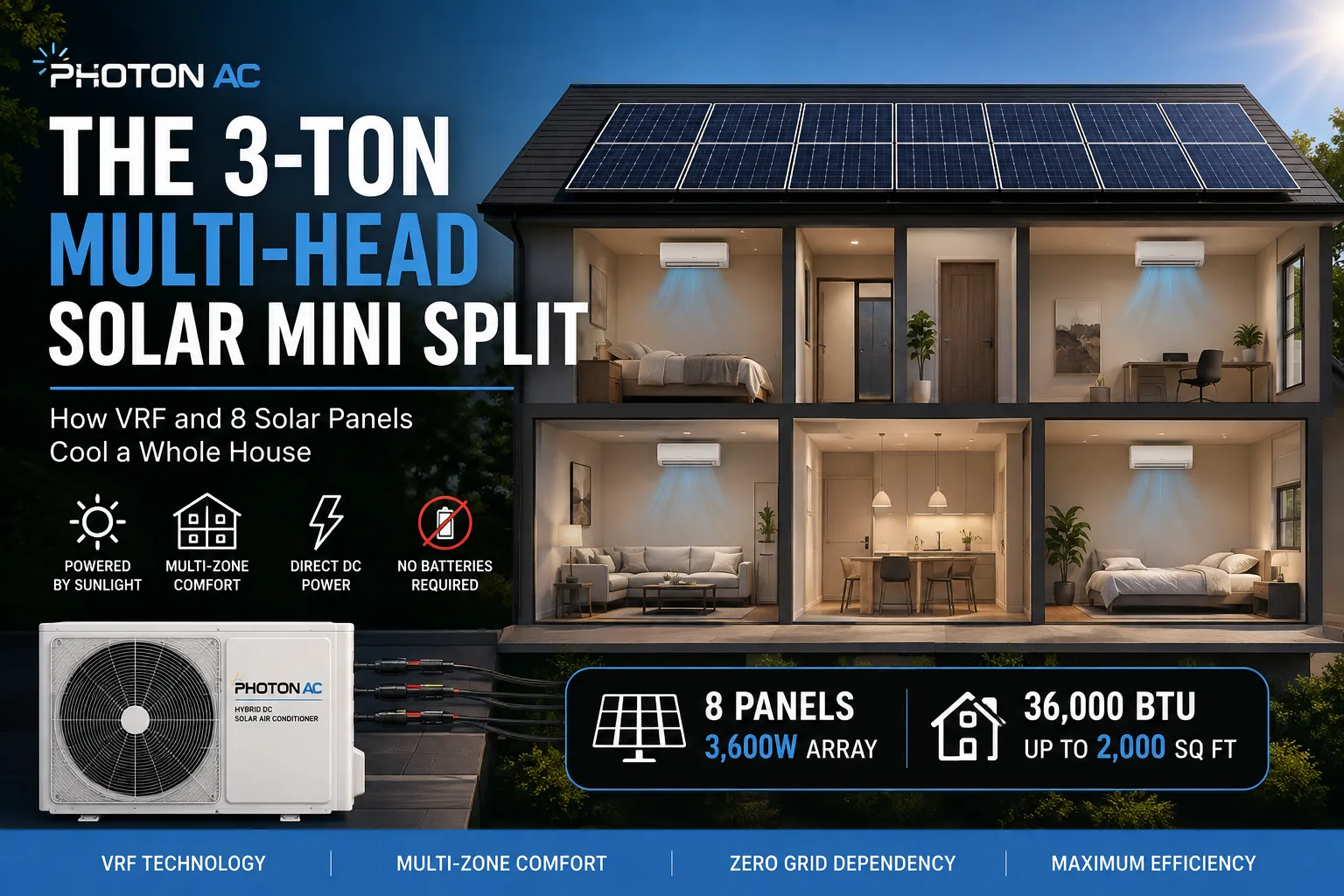
Most solar air conditioning stops at one room. A single head, a couple of panels, a bedroom that stays comfortable while the rest of the house bakes. That works for a shop or a casita. It does not work for a 1,800-square-foot home.
The 3-ton multi-head is the answer to that gap. One outdoor condenser, multiple indoor heads, 36,000 BTU of capacity, and an 8-panel solar array feeding it directly. It cools a whole house on sunlight, and it does it without a battery bank.
Here is how the system actually works.
What "3-Ton Multi-Head" Means
A ton is a unit of cooling capacity, not weight. One ton equals 12,000 BTU per hour. Three tons equals 36,000 BTU/h — enough to condition roughly 1,500 to 2,000 square feet in most climates, less in the desert Southwest, more in milder regions.
"Multi-head" means that capacity is split across several indoor units instead of dumped into one. A single outdoor condenser connects by refrigerant line to multiple wall-mounted air handlers, each with its own thermostat and its own remote.
That's the structural difference from a conventional central system. A central AC has one thermostat governing one big air handler pushing air through ductwork to every room. You cool the whole house or you cool none of it, and the hallway thermostat decides for everybody.
A multi-head system gives every zone its own setpoint. The primary bedroom at 68 at night. The living room off while nobody's in it. The home office at 72 during work hours. Each head runs independently.
How VRF Makes Multi-Zone Work
Multi-zone only works well because of VRF — Variable Refrigerant Flow. This is the engineering that separates a modern multi-head from an old-school system with a couple of condensers bolted to the wall.
In a conventional single-stage air conditioner, the compressor has two states: on and off. It slams to 100% capacity, overshoots the setpoint, shuts off, coasts until the room warms up, then slams on again. Every one of those startups is a current spike, and every cycle swings the room temperature and lets humidity creep back in.
A VRF system replaces that with an inverter-driven compressor that varies its speed continuously — anywhere from roughly 20% to 100% of capacity. Instead of cycling, it finds the output that matches the actual heat load in the house and holds there.
The "variable refrigerant flow" part is what happens downstream. Each indoor head has an electronic expansion valve that meters exactly how much refrigerant that zone gets, moment to moment. When the bedroom is calling for cooling and the living room isn't, the valves throttle flow toward the bedroom and the compressor drops to a fraction of full speed to match. When afternoon sun hits and three zones call at once, flow redistributes and the compressor ramps up.
Three consequences fall out of that:
Tighter temperature control. Instead of cycling ±3°F around the setpoint, a modulating system holds within about a degree.
Better dehumidification. Long, low-speed runtime pulls more moisture out of the air than short bursts at full blast, because the coil stays cold continuously.
Dramatically lower average power draw. A compressor loafing at 30% capacity draws a fraction of what it draws at full tilt — and it spends most of the day there.
That last point is the whole reason a solar array can carry this system.
The 8-Panel Array: 3,600 Watts of Direct DC
The system ships with eight 450-watt solar panels — a 3,600-watt array.
The important part isn't the wattage. It's that the panels feed the condenser directly. There is no string inverter, no charge controller, and no battery bank between the array and the unit.
Conventional solar has to convert DC from the panels into AC for your house, and then your inverter-driven AC unit converts that AC right back into DC to run the compressor. Two conversions, losses at both, plus the cost and failure points of the inverter itself.
Photon AC's hybrid design skips the round trip. The panels connect straight to the condenser, where onboard MPPT (Maximum Power Point Tracking) electronics pull the most available power out of the array and feed the DC bus that drives the compressor. Sunlight goes to cooling without a detour.
The hybrid part is what makes it practical: the unit blends solar and grid power automatically and continuously. When the array is producing more than the compressor needs, the system runs on solar alone and pulls nothing from the meter. When a cloud passes or the load climbs above what the panels can deliver, it seamlessly tops up from the grid — no switchover, no interruption, no flicker in the room. At night, it runs on grid power like any other high-efficiency mini split.
You never manage it. There's no mode to select. The system arbitrates in real time.
Why the Timing Works So Well
Solar output and cooling demand rise and fall together. Peak sun is peak heat. The hours when your array is producing hardest — roughly 10am to 4pm — are the same hours your AC is working hardest and the same hours utilities charge the most under time-of-use rates.
That's a rare alignment in solar. Most residential arrays overproduce at midday when nobody's home and underproduce at 7pm when everyone gets back and turns everything on, which is exactly why batteries got expensive and popular.
A solar AC doesn't have that problem. The load is the midday load. There's nothing to store, because there's nothing to shift.
A 3,600-watt array in a sunny climate produces meaningful energy across a long summer day. A VRF compressor modulating to match a real cooling load draws well under its nameplate maximum most of that time. Through the middle of the day, the array frequently covers the system outright.
System at a Glance
| Specification | Detail |
|---|---|
| Cooling capacity | 3 tons / 36,000 BTU per hour |
| Configuration | Multi-head — one outdoor condenser, multiple independently controlled indoor zones |
| Compressor | Inverter-driven, variable speed (VRF) |
| Zone control | Electronic expansion valve at each indoor head |
| Solar array | 8 panels × 450 W = 3,600 W (3.6 kW) |
| Power path | Panels feed the condenser directly via onboard MPPT — no string inverter, no charge controller |
| Battery required | No — automatic solar-and-grid blending |
| Operation | Cooling and heating (heat pump) |
Who This System Is For
If you're in Arizona, Texas, Nevada, Florida, or anywhere summer electric bills run into the hundreds, this is where the math is most aggressive.
Cabins, barndominiums, shops with living quarters, and rural builds where central AC would mean a generator or a battery bank you can't justify.
If your existing central AC and ductwork are near end of life, a multi-head lets you skip duct repairs entirely and gain zoning at the same time.
Cooling is typically the largest line item on a summer electric bill in hot climates. Attacking it directly moves more than swapping bulbs.
The Short Version
Three tons of cooling, split into independently controlled zones. A VRF inverter compressor that modulates continuously instead of cycling, so it sips power most of the day. Eight 450-watt panels feeding it DC directly with no inverter, no charge controller, and no batteries. Automatic solar-to-grid blending so it just works.
It's the whole house, on sunlight, during the hours it costs the most to cool.
Frequently Asked Questions
How many rooms will a 3-ton multi-head cool?
Typically two to four zones, depending on how the 36,000 BTU is divided and how large each room is. The right split depends on your layout and climate — a proper load calculation determines it.
Do I need batteries?
No. The hybrid design blends solar and grid power automatically, so the system runs on sunlight when it's available and grid power when it isn't. Batteries are optional, not required.
What happens at night or on cloudy days?
The unit draws from the grid and operates as a high-efficiency inverter mini split. Cooling performance doesn't change — only the power source does.
Can I add panels later?
Array sizing is matched to the system's input specification. Talk to our team before changing panel count or configuration.
Does this work off-grid?
Yes, with the right supporting setup. Off-grid operation depends on your existing power system — contact us to configure it correctly.
Is it a heat pump?
Yes. The system heats as well as cools, so it handles shoulder seasons and winter in most climates.
Cool the Whole House on Sunlight
See the 3-ton multi-head solar VRF system, or run a free sizing calculation to find the right configuration for your home.