Photon AC ·
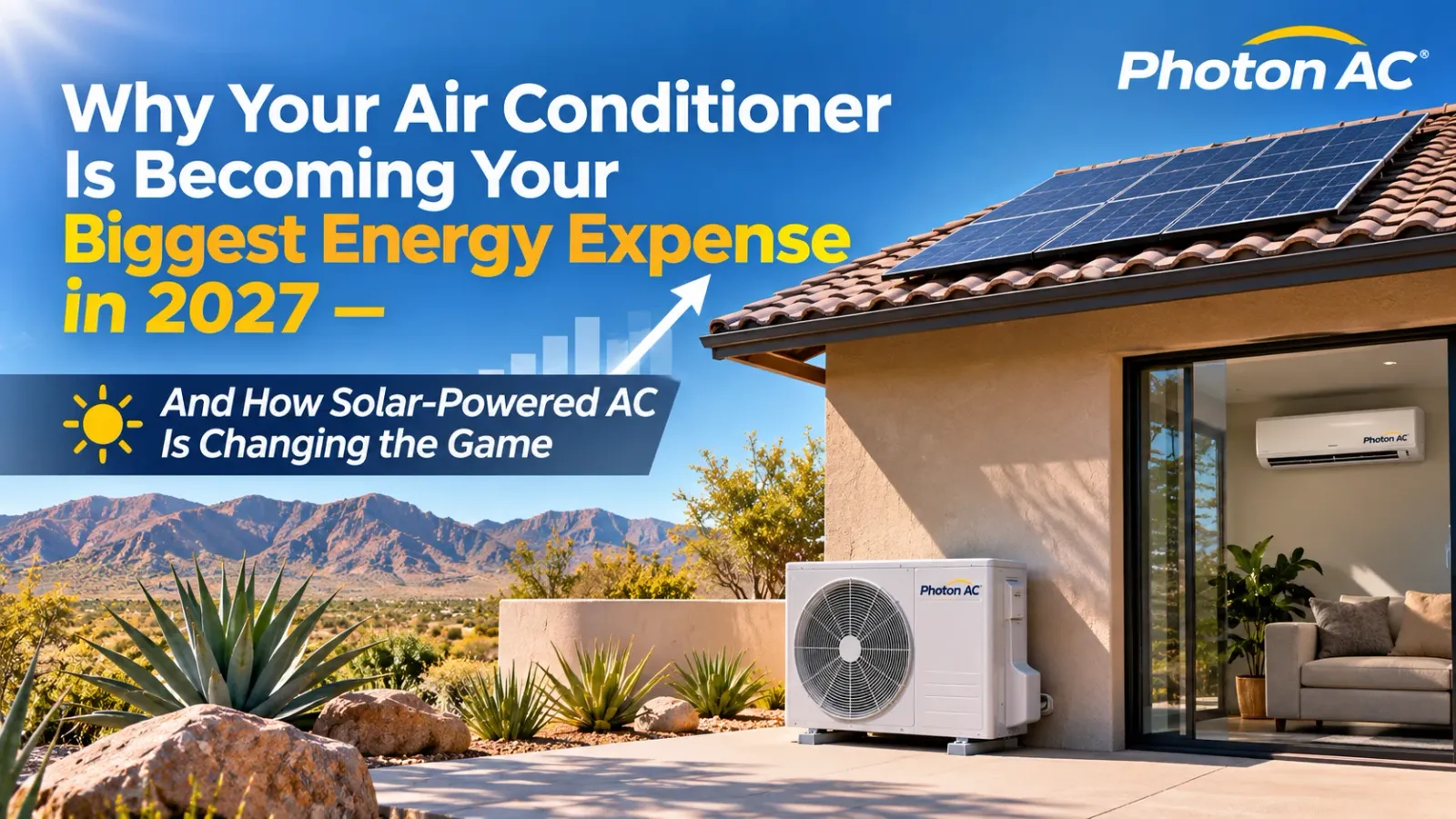
Why Your Air Conditioner Is Becoming Your Biggest Energy Expense in 2027 — And How Solar-Powered AC Is Changing the Game
For millions of homeowners across the United States, air conditioning is no longer just a convenience. It is an essential part of everyday life.
From the scorching summers of Arizona and Nevada to the long cooling seasons in California, Texas, and the Southwest, keeping a home comfortable can consume a substantial amount of electricity. And as electricity prices continue to change, homeowners are looking for better ways to keep their homes cool without relying entirely on the traditional power grid.
According to the U.S. Energy Information Administration (EIA), average residential electricity prices are projected to reach approximately 18.68 cents per kilowatt-hour in 2027, compared with 17.30 cents in 2025.
For homeowners who run air conditioning for extended periods, those increases can make an already expensive utility bill even more difficult to manage.
But what if your air conditioner could use the same sunlight beating down on your roof to help power the cooling inside your home?
That is exactly where solar-powered air conditioning comes into the picture.
Solar-powered mini split systems are changing how homeowners think about residential cooling by allowing them to use available solar energy directly, reduce their reliance on grid electricity, and take advantage of the hours when the sun is strongest.
Let's explore why solar-powered air conditioning is becoming an increasingly attractive option in 2027.
1. The Rising Cost of Keeping Your Home Cool
Air conditioning is one of the largest electricity consumers in many homes, particularly in regions with extremely hot summers.
Unlike appliances that operate intermittently, an air conditioner may run for hours at a time, sometimes nearly continuously during periods of extreme heat.
The harder an AC system has to work, the more electricity it generally consumes.
Several factors contribute to the cost of residential cooling:
- Longer cooling seasons: Many Western states experience extended periods of high temperatures, requiring homeowners to operate their AC systems for months.
- Electricity prices: Utility rates vary by location, provider, and rate plan, making cooling more expensive in some markets.
- Peak electricity demand: Some utilities charge higher rates during specific hours when electricity demand is greatest.
- Home insulation: Poor insulation, air leaks, and inadequate windows can increase the workload on an air conditioning system.
- System efficiency: Older or improperly sized equipment can consume more electricity than necessary.
The EIA tracks residential electricity prices nationwide, and its projections show that the average cost of residential electricity is expected to remain higher in 2027 than in 2025.
For homeowners, this creates an important question: Is there a better way to power the equipment responsible for keeping their homes comfortable?
Explore residential electricity data from the U.S. Energy Information Administration.
2. Why the Western United States Is Perfectly Positioned for Solar Cooling
The Western United States has some of the country's most favorable conditions for solar energy.
States such as Arizona, California, Nevada, New Mexico, Utah, and parts of Colorado experience abundant sunshine throughout much of the year.
Interestingly, these are also areas where air conditioning is particularly important.
This creates a natural opportunity: The hours when homeowners need the most cooling often overlap with the hours when solar panels can produce electricity.
Consider a typical summer afternoon in Arizona, Nevada, or Southern California.
The sun is shining, temperatures are climbing, and residential air conditioners are working hard to maintain comfortable indoor temperatures.
Instead of purchasing all the electricity needed to operate an air conditioner from the utility company, homeowners can potentially use solar-generated electricity to power some or all of their cooling demand.
Solar energy production varies by location, season, panel orientation, shading, and weather conditions. However, the Western and Southwestern United States generally offer excellent solar resources.
The National Renewable Energy Laboratory (NREL) provides solar resource maps showing the distribution of solar energy potential throughout the country.
Explore NREL's solar resource maps.
For homeowners in sunny climates, solar-powered air conditioning offers an opportunity to put abundant daylight to work.
3. Traditional Solar Isn't the Only Way to Power Your Air Conditioner
When most people think about solar energy, they picture a large rooftop installation with dozens of panels, an inverter, batteries, and a significant upfront investment.
While traditional whole-home solar systems can be effective, they aren't the only way to incorporate solar energy into a home.
A dedicated solar air conditioning system takes a different approach.
Rather than installing an entire solar power system to offset household electricity consumption, homeowners can install a solar-powered air conditioning system designed specifically for cooling.
This can be particularly attractive for homeowners who want to:
- Reduce the amount of grid electricity their air conditioner consumes.
- Cool a garage, workshop, addition, or guest house.
- Add air conditioning to an area without expanding their existing HVAC system.
- Explore solar energy without committing to a whole-home solar installation.
- Reduce daytime electricity consumption.
The advantage is that solar power can be directed toward one of the home's largest electricity-consuming appliances: air conditioning.
For many homeowners, that is a much more targeted approach to energy savings.
4. How Solar-Powered Mini Splits Are Changing Home Cooling
One of the most interesting developments in residential solar cooling is the combination of solar technology and ductless mini split air conditioning.
Traditional mini splits already offer an alternative to conventional central air conditioning by allowing homeowners to cool individual rooms or designated areas without requiring an extensive duct system.
Solar-powered mini splits take this concept further.
These systems are designed to accept electricity from solar panels and use that energy to operate the air conditioning system.
Depending on the system design, solar-powered mini splits can use dedicated DC solar input alongside an AC power connection.
This allows the system to take advantage of available sunlight while retaining access to conventional household electricity.
The result is a hybrid cooling solution that combines solar energy with traditional power.
What Makes Hybrid Solar AC Different?
A hybrid solar air conditioner is designed to operate using more than one available power source.
During daylight hours, the system can use electricity generated by its solar panels. When solar production is insufficient or unavailable, the system can draw additional electricity from its household AC connection.
This provides several advantages:
- Solar energy can be used directly during the day.
- Batteries are not necessarily required for normal daytime solar operation.
- Household electricity provides an additional power source.
- The system can continue operating when solar production decreases, provided AC power is available.
- Homeowners can reduce grid electricity consumption without depending on battery storage.
Unlike a conventional battery-based solar installation, a compatible direct-solar system can use available solar energy without first storing it in batteries.
For homeowners who primarily need cooling during daylight hours, this is an important distinction.
5. Can You Run an Air Conditioner Directly From Solar Panels Without Batteries?
Yes. Certain specially designed solar air conditioning systems can operate directly from solar panels without requiring a battery bank.
However, not every air conditioner can do this.
Conventional air conditioners typically require a compatible AC electrical supply. Simply connecting solar panels to a traditional air conditioner will not work.
Direct-solar air conditioners are designed with compatible power electronics that allow them to accept solar DC electricity.
This is what makes dedicated solar mini split systems different.
How Does It Work?
A typical hybrid solar mini split installation includes:
- Solar panels: Convert sunlight into DC electricity.
- Solar input electronics: Manage the incoming solar power.
- Air conditioning system: Uses the available electrical power to operate the compressor and cooling components.
- Household AC connection: Provides supplemental power when solar production is insufficient.
The exact electrical configuration depends on the manufacturer and system specifications.
It's also important to understand that operating without batteries does not mean operating without electricity after sunset. When sunlight is unavailable, a hybrid system needs another compatible power source if continued cooling is desired.
For homeowners who want to reduce daytime grid consumption without investing in a large battery installation, this can be a compelling option.
6. Why Mini Split Technology Makes Solar Cooling More Accessible
Mini split air conditioners have become popular because of their flexibility.
Unlike traditional central air conditioning systems that distribute conditioned air throughout a home using ductwork, mini splits allow homeowners to cool specific rooms and spaces.
This creates opportunities for more targeted cooling.
For example, a homeowner might use:
- A 12,000 BTU system for a bedroom, office, or smaller living space.
- An 18,000 BTU system for a larger room or designated living area.
- A 24,000 BTU system for a larger space, depending on insulation, climate, ceiling height, and other sizing factors.
- A multi-zone system to cool multiple rooms using one outdoor system.
Correct system sizing is critical. Square footage alone does not determine the required cooling capacity. Insulation, windows, sun exposure, occupancy, ceiling height, and local climate all affect cooling requirements.
Solar-powered mini splits can also be useful for applications beyond traditional bedrooms and living rooms.
Homeowners are increasingly interested in cooling:
- Detached garages.
- Workshops and hobby spaces.
- Guest houses and casitas.
- Home offices.
- RV and off-grid applications.
- Cabins and remote properties.
- Additions and converted spaces.
Instead of cooling an entire home, homeowners can focus on the spaces they actually use.
7. Is Solar-Powered Air Conditioning Worth It in 2027?
Whether solar-powered air conditioning makes financial sense depends on several factors.
The biggest considerations include:
Local electricity rates
Homeowners paying higher electricity rates may have more potential to benefit from reducing grid consumption.
Daily cooling requirements
A system that operates frequently during daylight hours may have more opportunities to use solar electricity directly.
Available sunlight
Solar panel production depends on geographic location, season, shading, orientation, and weather.
System size
The required BTU capacity and compatible solar panel configuration depend on the cooling application and manufacturer's specifications.
Installation costs
The total investment should include the air conditioning equipment, solar panels, electrical components, installation, and any necessary permitting.
Understanding Potential Savings
Solar-powered air conditioning does not automatically mean zero electricity bills.
Actual savings depend on how much electricity the system would otherwise consume, how much solar energy it uses, and the household's utility rate structure.
A homeowner should compare the system's actual energy consumption and expected solar contribution against the cost of purchasing electricity from their utility.
The best way to evaluate a system is to calculate the expected reduction in grid electricity consumption rather than relying on generalized savings percentages.
For homeowners in high-sunlight areas, this can be an especially interesting opportunity.
8. Meet Photon AC: A Different Approach to Residential Cooling
At Photon AC, we believe homeowners should have more options when it comes to powering their air conditioning.
Based in Arizona and serving customers across the United States, Photon AC focuses on making solar-powered air conditioning more accessible through hybrid solar mini split systems.
Our systems are designed to allow homeowners to harness solar energy directly during daylight hours while maintaining the flexibility of household AC power.
Rather than requiring a homeowner to install an entire rooftop solar system just to start reducing the electricity used for cooling, Photon AC offers dedicated solar air conditioning solutions.
Solar Cooling Designed for Real Homes
Photon AC offers multiple system configurations for different cooling applications.
Whether you're cooling a bedroom, a larger living area, a workshop, or multiple rooms, choosing the right system is essential.
Our product lineup includes:
- 12,000 BTU solar mini split systems.
- 18,000 BTU solar mini split systems.
- 24,000 BTU solar mini split systems.
- Multi-zone solar air conditioning systems.
- Ducted solar air conditioning solutions.
Each system has specific cooling capacity and solar input requirements. Homeowners should review the individual product specifications when selecting a system.
Our goal is straightforward: make it easier for homeowners to take advantage of solar energy while keeping their homes comfortable.
Explore solar-powered air conditioning at PhotonAC.com.
9. The Future of Home Cooling Is Changing
For decades, homeowners have largely depended on traditional electricity to power their air conditioning systems.
But advances in solar technology and inverter-driven air conditioning are creating new possibilities.
Solar-powered mini splits offer a way to combine two technologies that naturally complement one another: solar electricity and air conditioning.
The sun provides energy during the same hours when cooling demand is often highest.
For homeowners throughout the Western United States, this is particularly relevant. But the opportunity extends well beyond the Southwest.
From California and Nevada to Texas, Colorado, and other sunny regions, homeowners are exploring ways to make their cooling systems more energy-conscious.
Solar-powered air conditioning isn't simply about installing more solar panels. It's about rethinking how the equipment inside a home receives and uses electricity.
And that is a change worth paying attention to.
Frequently Asked Questions About Solar-Powered Air Conditioning
Can a solar-powered air conditioner run without batteries?
Yes. Certain direct-solar hybrid air conditioners can operate using electricity supplied directly by solar panels without requiring batteries. When solar production is insufficient, a compatible AC power source can provide additional electricity.
Do solar mini splits work at night?
Hybrid solar mini splits with a compatible household AC connection can continue operating after sunset using household electricity. Battery operation is also possible when supported by the system and properly configured.
How many solar panels does a solar air conditioner need?
The number of panels depends on the air conditioner's specifications, solar input requirements, panel wattage, and operating conditions. Always follow the manufacturer's recommended configuration.
Are solar-powered mini splits worth it?
They can be worthwhile for homeowners who want to reduce grid electricity consumption, particularly in areas with abundant sunlight and substantial cooling demand. The financial return depends on equipment costs, installation, local utility rates, and actual solar production.
Can I install solar AC in my garage or workshop?
Yes. Solar mini splits can be suitable for garages, workshops, detached buildings, guest houses, and other spaces, provided the system is correctly sized and installed.
Does solar AC work on cloudy days?
Solar panels can still generate electricity in cloudy conditions, although production generally decreases. A hybrid system can use its compatible household AC connection to supplement available solar power.
Is solar AC only useful in Arizona?
No. Arizona has excellent solar resources, but solar-powered air conditioning can be relevant throughout much of the Western United States and other regions with sufficient sunlight and cooling demand.
Ready to Rethink the Way You Cool Your Home?
Your air conditioner doesn't have to rely entirely on electricity purchased from the utility company.
With solar-powered mini split technology, homeowners have another way to approach residential cooling.
Whether you're looking to cool a single room, a garage, a workshop, or a larger living space, Photon AC offers solar-powered cooling solutions designed to put the sun to work.
Cool Your Home. Harness the Sun.
Explore the complete lineup of solar-powered air conditioning systems at PhotonAC.com.