
Homeowner Guide · · By Joel Gee, Photon AC
Why Is My Electric Bill So High in 2026? The HVAC Gap and Solar Air Conditioning
If your summer electric bill regularly climbs above $200–$300, solar air conditioning is worth a serious look. You already pay to keep your home comfortable. Why not put sunlight to work powering your cooling during the day—and put your money toward a system you own instead of relying entirely on utility electricity?
The HVAC Gap: Why Your Summer Electric Bill Can Be So Much Higher
You still use your refrigerator, lights, television, and appliances when the weather is mild. Then summer arrives, the air conditioner runs for hours, and the electric bill jumps. In many homes, cooling is a major part of that increase.
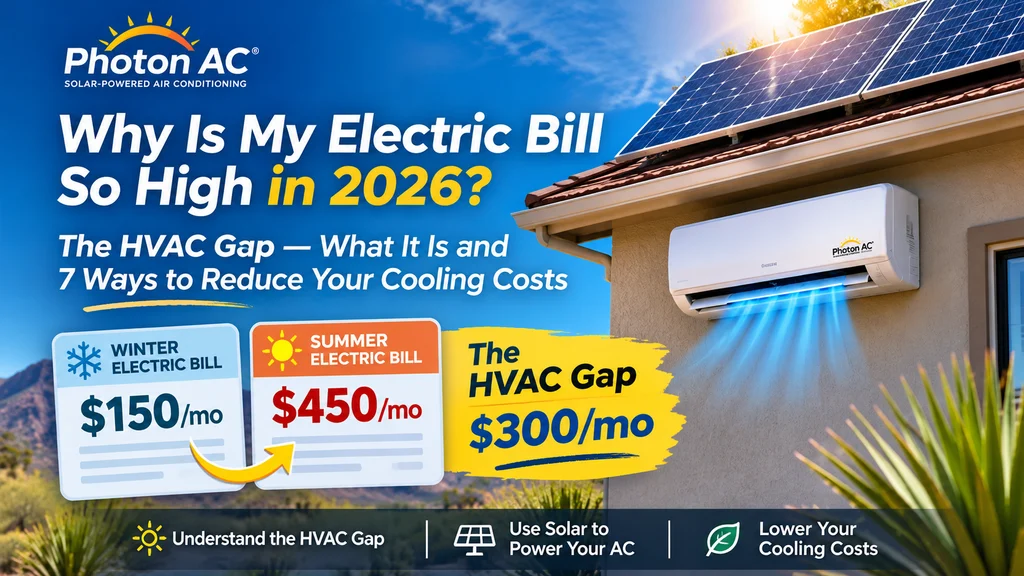
At Photon AC, we call that seasonal difference the HVAC Gap. Imagine a $150 bill during a lower-cooling month and a $450 summer bill: that is a $300 monthly gap. The example illustrates the idea; it is not measured AC use or a savings estimate. Other household loads and rate changes can affect the difference.
The important question is simple: why keep purchasing all of your daytime cooling electricity when the sun can supply it? A solar air conditioner addresses the cooling load directly. Instead of only looking for ways to use your air conditioner less, you can change where its operating power comes from.
1. Summer Bills Over $200–$300? Solar AC Is Worth a Serious Look
If you regularly see summer electric bills above $200 or $300, particularly while running AC through the day, you have a practical reason to look at solar air conditioning. That bill is already money going toward keeping your home comfortable.
You do not need to become an energy expert or complete a list of home upgrades before having the conversation. Bring a recent summer bill, tell us which areas you want to cool, and talk with a Photon AC dealer about a system that fits your home.
The $200–$300 range is a conversation starter, not a guaranteed savings or payback cutoff. The next step is straightforward: compare a suitable installed system with what you already spend on cooling. You may be able to start with one main living area rather than replace every part of your existing HVAC system.
2. Put a Single-Head Solar Mini Split in Your Main Living Area
One way to start is with a single-head solar mini split in the area where your household spends the most time: a living room, great room, or open-plan kitchen and dining space.
During the day, solar panels power that unit directly. When sunlight and array output are sufficient, the mini split can handle its cooling load entirely on solar, taking on cooling that your central system would otherwise need to provide.
Can you use your central system to recirculate the air?
In a suitable home, your installer may recommend using the central system's fan-only or recirculate setting to help move air while the solar mini split cools the main area. This can let you keep your existing system and add solar-powered cooling where you use it most.
The central blower still uses electricity, and its ability to distribute that cooling depends on your layout, return-air paths, and ducts. Have your installer confirm the setup; one indoor unit is not automatically a replacement for cooling every closed bedroom.
Explore our single-zone solar mini splits and learn more about whole-house AC versus zoned cooling.
3. Use a Multi-Head Solar System to Cool Several Zones
If you want solar cooling in more than one room, a multi-head system connects multiple indoor units to one outdoor system. You can bring cooling directly to a living area, bedrooms, or a home office instead of relying on air moving from a single location.
Each indoor unit serves its own zone, so you can set temperatures around how your family uses the home. It is a practical approach for households that want more of their occupied spaces served by solar-powered air conditioning.
The advantage is not just individual room control. With sufficient solar power available, you are using sunlight to supply the cooling system rather than purchasing all of that operating electricity from the utility.
See our multi-head solar air conditioning system or read the multi-head solar mini split guide.
4. Choose Ducted Solar AC to Serve Multiple Areas
Prefer vents and a concealed air handler rather than wall-mounted indoor units? A ducted solar air conditioner distributes conditioned air through suitable ductwork to multiple areas.
This gives you another route to solar-powered comfort: one concealed system serving the rooms within its designed capacity. It can be a good option when you want the look and air distribution of a ducted installation with direct-solar daytime power.
Your installer can recommend the areas to serve and confirm suitable ducts and controls. Serving several areas does not automatically mean every room has independent temperature control; that depends on the installed design.
Explore the Photon AC ducted solar system or read about solar-powered central-style air conditioning.
5. You Do Not Need Batteries to Run a Photon AC Solar Air Conditioner
Batteries are not required. The solar panels connect directly to the Photon AC unit. When sunlight and solar array output are sufficient for the cooling demand, the air conditioner can run 100% on solar power during the day—without batteries.
That direct connection uses the panels' DC electricity without first charging and discharging a battery or converting the solar supply to AC through an external solar inverter. The sunlight goes to work powering your comfort without those extra storage and conversion steps.
You can add batteries if you would like stored power for nighttime operation, but that is a separate, optional setup. You need a separate solar array to charge those batteries, along with compatible charging equipment and a correctly designed battery-and-inverter supply. The panels plugged directly into the air conditioner power the unit; they do not charge the optional batteries.
Your operating options are:
- Daytime solar: panels connect directly to the unit, with no batteries required. Sufficient solar output can cover 100% of the operating demand.
- Grid power: a compatible AC connection can supplement solar or run the unit when solar is unavailable.
- Optional nighttime batteries: a separate solar array charges the batteries, and compatible charging and inverter equipment supplies power after sunset.
- Generator power: an appropriately rated, compatible generator installation can provide another AC power source.
Battery storage and its separate charging setup are optional, not a requirement for direct-solar daytime cooling. Discuss your preferred day-and-night power plan with your installer. Our hybrid solar AC day-and-night guide explains the distinction.
6. Who Do You Want to Pay to Stay Comfortable?
Air conditioning needs energy. The choice is whether you keep purchasing all of that energy from the utility or invest in a system you own that can use sunlight during the day.
With direct-solar AC, you do not have to install solar for every appliance in your home to start. A dedicated array can power the cooling equipment itself. You can start with a main living area, serve several zones, or choose a ducted installation.
When solar covers the unit's entire operating load, no grid electricity needs to be purchased to run that unit during those hours. That is the daytime advantage: the power comes from your panels, not the utility meter. Equipment and installation still have a cost, and nighttime or supplemental power is separate.
You cannot control the utility's next rate change. Rates can move up or down, but cooling supplied by your own solar array reduces your reliance on purchased electricity during those hours. For current electricity-price context, see the U.S. Energy Information Administration's electricity outlook.
This is about more control over the power behind your comfort—not accepting that every sunny afternoon has to mean another afternoon of utility-powered cooling. Learn how direct-solar air conditioning works or explore solar AC for your home.
Is Solar Air Conditioning Worth It in 2026?
If cooling drives your summer electric bill above $200–$300 and you use air conditioning during the day, solar AC deserves a serious conversation. It directly addresses a recurring expense with equipment that uses the same sunlight heating up your home.
You do not need to work through a home-improvement checklist first. Take a look at a recent summer bill and decide which rooms you want comfortable. A dealer can explain whether a single-head mini split, a multi-head system, or a ducted installation is the right fit and give you an installed quote.
Actual results depend on your usage, available sunlight, utility rates, and installation. The point is not a universal savings number: it is the opportunity to own the system supplying your daytime cooling instead of buying all of its operating power from the utility.
Why Photon AC Is Making Solar Cooling More Accessible
At Photon AC, we believe staying comfortable should not mean depending entirely on utility electricity. Our direct-solar systems give homeowners a way to put sunlight to work, with single-zone, multi-head, and ducted options for different homes.
You already spend money keeping your home cool. Take a look at what a system you own could do with the sunshine available at your home.
Explore our solar-powered air conditioning systems or connect with a local Photon AC dealer. Bring a recent summer bill and tell us which areas you want to cool. We will help you understand your options.
Frequently Asked Questions About Solar Air Conditioning
Why is my electric bill so high in the summer?
Your air conditioner runs longer as outdoor temperatures rise, which can make cooling a major contributor to a higher summer electric bill. Photon AC calls that seasonal bill increase the HVAC Gap. Direct-solar air conditioning gives you another way to power that daytime cooling demand.
What is the HVAC Gap?
The HVAC Gap is Photon AC's term for the difference between your lower-cooling electricity bill and your summer bill. For example, a $150 baseline bill and a $450 summer bill have a $300 gap. Those are illustrative amounts, not a measured AC cost or a savings estimate; rates, billing days, and other loads can also affect the difference.
Does solar AC make sense if my summer electric bill is over $200 or $300?
A recurring summer electric bill above $200–$300 is a good reason to take a serious look at solar air conditioning, particularly if you use AC during daylight. It is a starting point for a conversation, not an automatic savings or payback threshold. A dealer can use a recent bill and your cooling needs to recommend a suitable installation.
How can I reduce my AC electricity bill?
Powering compatible air conditioning directly from solar panels can reduce the grid electricity purchased for daytime cooling. Photon AC offers single-zone mini splits, multi-head systems for several zones, and ducted systems for multiple areas. The amount of grid electricity displaced depends on sunlight, use, and the installation.
Can I use a solar mini split with my existing central air conditioner?
Yes. A solar mini split can cool the main living area while the existing central AC remains available. In suitable homes, an installer may recommend using the central system's fan-only recirculate setting to help move air. The blower still uses electricity, and airflow between rooms depends on the home's layout and ductwork; one indoor unit is not automatically a whole-home solution.
Can solar panels run an air conditioner?
Yes. Solar panels can power compatible air conditioning systems. Direct-solar mini splits accept compatible DC solar input; conventional AC equipment requires suitable power-conversion equipment. Required solar capacity depends on electrical demand, sunlight, and the manufacturer's specifications.
Can a solar air conditioner run without batteries?
Yes. Photon AC solar air conditioners do not require batteries. The solar panels connect directly to the unit, which can run 100% on solar power when sunlight and array output are sufficient. Optional batteries are for stored power, such as nighttime operation, and require a separate solar array and compatible charging and power-supply equipment.
How many solar panels does it take to run a mini split?
Panel count depends on the mini split's electrical demand and input limits, panel wattage and electrical ratings, and available sunlight. Follow the manufacturer's recommended configuration and have a qualified installer check the complete array rather than relying on panel count alone.
What is the difference between single-zone, multi-head, and ducted solar AC?
A single-zone mini split uses one indoor unit for a main living area or other space. A multi-head system connects several indoor units to an outdoor unit for separate zones. A ducted solar system uses a concealed air handler and suitable ducts to deliver air to multiple areas. The right choice follows the home's layout and the areas you want to cool.
Does solar air conditioning work at night?
Solar panels do not generate electricity at night. A compatible Photon AC hybrid system can use an AC grid connection or a properly designed generator supply. Optional nighttime battery power requires a separate solar array to charge the batteries, compatible charging equipment, and an inverter supply that meets the unit's electrical requirements. The panels connected directly to the air conditioner do not charge those batteries.